The 5 most important things to know before buying a portable power station
In today's world, it is important to stay connected and have enough power at all times, whether you are camping in nature or working at a remote location. That is where a portable power station comes in handy.
At Totalcool, we understand how important a reliable power supply is. That is why we are happy to help you choose the perfect portable power station for your needs.
1. Determine how much power you need
Before diving into the world of portable power stations, it is good to consider the devices you want to power. Do you want to charge your smartphone and laptop while camping, or do you need to use power tools at a remote job site?
By mapping out your power requirements, you can choose a power station with the right capacity. Start by making a list of all the devices you want to power. Each device has a specific power consumption, usually expressed in watts (W). You can generally find this information on the device's label.
For example, a laptop might use 60 W, while a small refrigerator might use 100 W. Add up the wattage of all the devices you want to use at the same time to determine your total power requirement. It is wise to keep a margin of about 20% for devices that demand more power temporarily when starting up or that can cause spikes in power consumption.
2. Understand battery capacity and battery type
Battery capacity is an important factor in determining how long your power station can power your devices. The capacity is generally expressed in watt-hours (Wh). If you understand what this value means, you can better estimate what to expect from a power station.
For example, a 500 Wh battery can theoretically power a 50-watt device for 10 hours (500 Wh ÷ 50 W = 10 hours). This allows you to estimate how long a battery can run a particular device before it needs to be recharged. Keep in mind that the actual usage time may vary depending on factors such as device efficiency and the conditions in which you use it.
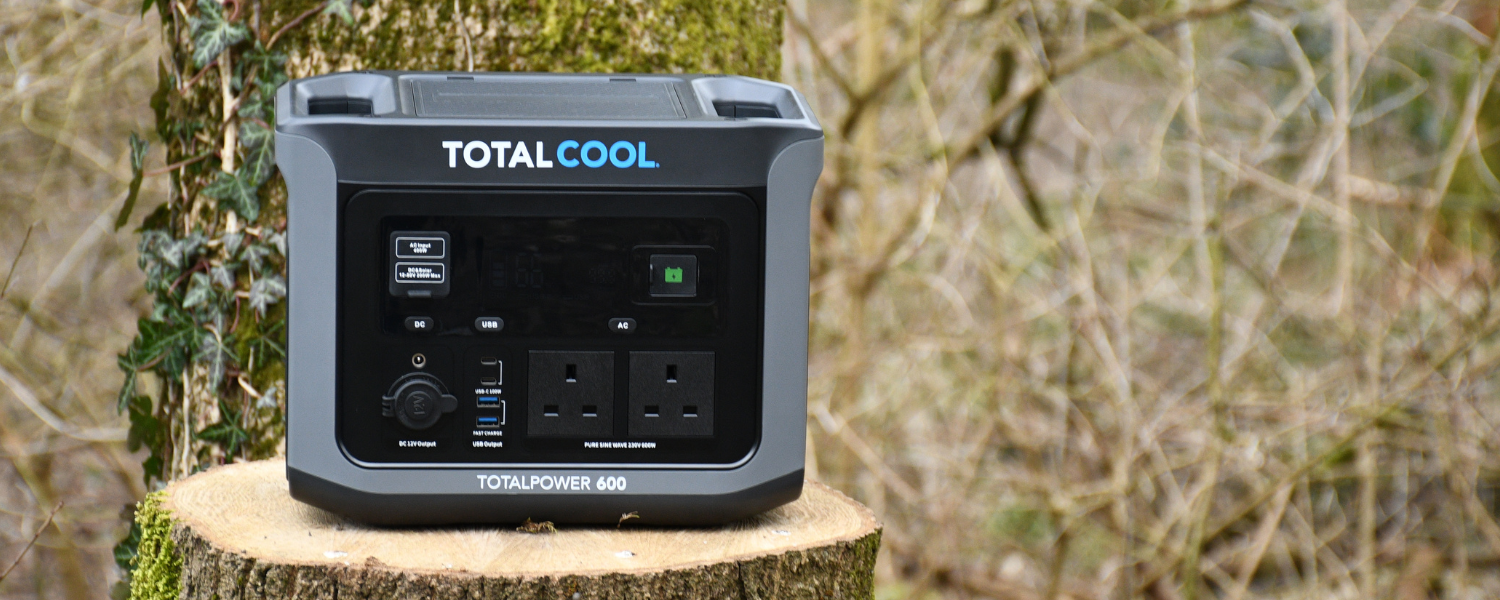
The battery type also affects the lifespan and performance. Lithium-ion batteries are common, but they may have a shorter lifespan than lithium iron phosphate (LiFePO4) batteries. These are used in the Totalpower 600 and Totalpower 1500 and offer a longer lifespan and better thermal stability.
3. Pay attention to inverter power and connections
The inverter in a portable power station converts the stored direct current (DC) into alternating current (AC) suitable for your devices. For example, if you want to use a 60 W laptop and a 100 W refrigerator at the same time, you need an inverter that can supply at least 160 W.
Because some devices, especially those with motors or compressors, need more power temporarily when starting up, we recommend adding about 20% extra margin to your calculation. This way, you can be sure that the inverter can handle these spikes without any problems.
Most portable power stations have a built-in surge capacity to handle the higher starting power of devices. This value is listed in the product specifications. For instance, the Totalpower 600 has a momentary surge power of 1000 W and the Totalpower 1500 can supply up to 2000 W momentarily.
4. Look at charging options and charging speed
How fast a portable power station can be charged depends on several factors, including the battery capacity and the power of the charger used. Manufacturers generally state how long it takes to fully charge the device via a standard wall outlet.
For example, if a power station has a capacity of 1000 Wh and the charger provides 200 W, a full charge is estimated to take about 5 hours.
However, the actual charging time may vary depending on the charger's specifications and the battery technology used. Charging via solar panels or a 12V car outlet may also take longer due to the lower charging power.
It is therefore wise to consult the manufacturer's guidelines for specific charging times and recommendations.
5. Look for extra features
Modern portable power stations have all kinds of extra features that make them even easier to use. For example, a display provides real-time information about battery status and power consumption. Features that improve portability, such as handles or wheels, make transport much easier.
Some power stations even offer wireless charging or the option to daisy-chain multiple units for extra power. At Totalcool, we are proud of our products, which come with a warranty of up to 2 years. This allows you to make your purchase with peace of mind.
Conclusion
Choosing the right portable power station starts with understanding your own power needs and finding a model that matches them. By taking factors such as power consumption, battery type, inverter power, charging options, and extra features into account, you can make an informed choice.
Explore our range of portable power stations. Need help making your choice? We are happy to help you further.